

Every year, elder fraud in America costs older adults more than $7 billion. What’s even more shameful is that some of the people swindling them are religious conmen who claim to speak for God. Sometimes the greatest threat to our faith lies inside the church, not outside its walls. Jesus warned His followers to beware of anyone who uses religion for personal enrichment by preying on the vulnerable. There are many of these false teachers in churches today. Do you know how to spot them?
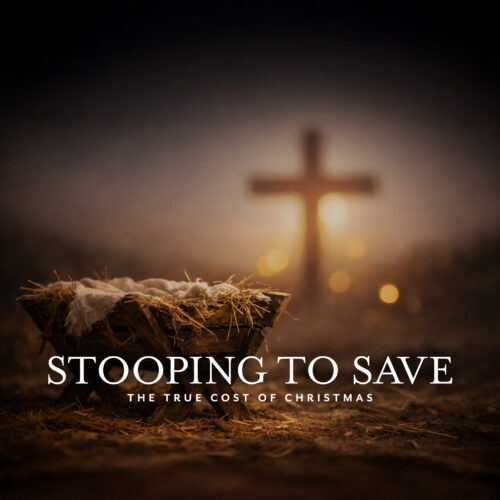
Stooping to Save: The True Cost of Christmas
Podcast: Play in new window | Download (Duration: 38:06 — 20.5MB) | Embed
Christmas draws our focus to the manger—the baby, the shepherds, the wise men. But have you ever looked deeper, past Bethlehem to see the whole story? The eternal Lord of glory didn’t cling to His rights or status; instead, He laid aside His privilege and became a servant, subjecting himself to mockery, torture, and eventually the shame of the cross. But the Christmas story doesn’t end in humiliation. Christ was raised from the dead and is now seated at the right hand of the Father in glory; and one day, every knee will bow before Him and every tongue will confess that He is Lord of all!
Audio Transcript
This morning we’re going to step aside from our “Through the Bible” series to focus our hearts and our thoughts for this Sunday on what this time of year really means. And you know, as a pastor, it can be daunting year after year after year after year—after decade—to ponder, “What do I say this Christmas? What in the world do I say? I’ve said everything, haven’t I, about Christmas?” Well, at least for one more year. I don’t know about next year, but I’ve had some thoughts tucked away for a very, very long time that I’ve never felt the go-ahead to teach on. This year, the Lord reminded me of those notes tucked away from many years ago, and I went and began exploring those. And I want to bring just a brief message this morning from quite an unusual Christmas passage.
I want to ask you if you would please take your Bibles and turn to the book of Philippians, chapter 2. Philippians, chapter 2. And we’re going to focus on verses 5 to 11 this morning.
Christmas is that wonderful time of year that draws our focus to the manger, that quiet scene, a newborn child, heaven coming down and touching earth. At least that’s what all the Christmas cards say it looked like. And it reminds us rightly, this time of year, that Christ stepped down into our world as a little baby. That’s what the manger reminds us of. But those manger scenes don’t tell us the whole story. They stop short of how far Christ came and how far He was actually willing to go.
So this morning I want to look at Christmas from a different angle. Not through the familiar Christmas passages. Not the angels, not the shepherds, not the wise men, but through a passage that’s never labeled Christmas. Yet this may be the most profound explanation in all of Scripture of why Christ came into the world.
So, if you have your place there in Philippians, chapter 2, let me invite you for just a moment to stand again, if you’re able, as we read God’s Word. Philippians, chapter 2, starting in verse 5.
“Let this mind be in you which was also in Christ Jesus, who, being in the form of God, did not consider equality with God something to be grasped, but emptied Himself, taking the form of a servant, being made in human likeness, and being found in appearance as a man, He humbled Himself and became obedient to the point of death, even death on a cross. Therefore, God also has highly exalted Him and given Him the name which is above every name, that at the name of Jesus every knee should bow, of those in heaven and of those on earth and of those under the earth, and that every tongue should confess that Jesus Christ is Lord, to the glory of God the Father.”
Amen. You may be seated.
I want to begin at verse 6. Look again, if you would, at verse 6. Speaking of Jesus, it says, “Who being in the form of God did not consider equality with God something to be grasped.” It’s important for us to remind ourselves that Jesus didn’t begin His life in Bethlehem. There was never a moment when He was not. The original word “being” in this verse carries the idea of continuous existence. He was always there, existing in the full glory of God.
One of my favorite verses tucked away in the Old Testament that brings this out so beautifully is Micah 5:2. It’s predicting the coming of Christ into the world. “But you, Bethlehem Ephrathah, though you are little among the thousands of Judah, yet out of you shall come forth to Me the One to be ruler in Israel.” Here it is: “Whose goings forth are from old, from everlasting.”
And John 1:1 highlights this as well. We studied this back at the beginning of the year as we crossed over into the New Testament. “In the beginning was the Word, and the Word was with God, and the Word was God.” Long before He was given the name Jesus at His birth, He had always existed as the Word of God. And when Jesus stood before His critics and declared, “Before Abraham was, I AM,” He was claiming the eternal name of God that was revealed to Moses back at the burning bush. Christmas doesn’t begin with a helpless baby. It begins with this One in eternity past.
The first part of verse 6 says Jesus was in the form of God. But the second part of verse 6 clarifies it. Look at this. Philippians 2:6b: “He did not consider equality with God something to be grasped.” First, the word “form” is much more than outward appearance. It describes one’s true nature. This is not saying that Jesus looked like God outwardly. It’s saying He was by His very nature God.
And to further define this, it goes on to use the word “grasp” there. It’s literally translated “robbery.” Taking what doesn’t belong to you. It means to clutch, to seize, to exploit. And it’s telling us that Jesus wasn’t trying to be equal with God because He already was. It wasn’t something He was striving to attain or that He needed to attain. If you are the CEO of the company, you don’t wake up every day striving to be CEO. Maybe one of your VPs is, you know, close on your heels, striving to take that position from you. But Jesus never strived to be God. He was by very nature God. Can I explain all that? No, I can’t. But I also can’t explain quantum entanglement. And yet it exists.
You know, you look at earthly rulers. Most earthly rulers that I’ve ever studied or witnessed in real time tend to cling to power. Power is a deadly thing. Once people get a taste of it, they never want to let it go. That’s why we’ve got people 80, 90 years old who can barely think straight, still trying to, you know, hang on to their position in Washington. Power is a hard thing to let go of. And earthly rulers tend to cling to power, but Jesus loosened His grip on it. Not because He lacked authority, but because love never insists on its own rights. There’s a whole message right there. Husbands, wives, parents, children, love never insists on its own rights. Chew on that one this week.
Look what verse 7 tells us: “He emptied Himself, taking the form of a servant, being made in the likeness of men”—or in human likeness. What does it mean that Jesus emptied Himself? It does not mean He emptied Himself of deity. God can’t cease to be God. If He did, He couldn’t save us. Man can’t redeem the world. Only God can. Instead, He emptied Himself of the privilege of His status, of His rights, but He was no less God by doing so. The Prince of Wales once entered a coal mine so that he could go and examine the conditions firsthand there. But when he was down in that mine, he was no less royalty than he was in the palace. That’s what Jesus did.
The King James renders this beautifully. It says He “made Himself of no reputation.” He gave up His status, His rights, His reputation. He willingly laid aside all of that in order to stoop low and become one of us, to experience hunger and exhaustion and temptation and pain and slander and criticism and even death.
Just think about what that means in everyday terms. It’s honestly too much to take in. The One who shaped the galaxies had to learn how to grip a hammer in the carpenter shop. The One whose voice thundered at creation, “Let there be light,” now His voice cried as an infant. He had to learn to form words as a young child. The Prince of Glory allowed Himself to be mocked and cursed by the very ones He created. He endured every struggle, every sorrow, every heartache that we do.
And that matters more than we might imagine. Some people assume that God understands what we go through in theory, but Christmas tells us that He understands it by experience. We can never stand before Him one day and say, “You don’t know what it’s like to go through what I went through.” Because He did, and much more. The incarnation shows us that He takes our suffering seriously. He didn’t save us from a distance. He came down into the muck and the mire to live alongside us, to experience everything that we do. He doesn’t observe from a safe distance. He enters into our mess.
But that’s not even all. He didn’t just choose to experience a normal life. He chose to become the lowliest kind of servant. The original word in this verse is the word doulos. Not helper, not volunteer, slave. And not just a slave, the lowest form of slave. In the time of Jesus, this word was used to describe the lowest social category imaginable. Jesus didn’t enter history as a consultant. He came as the lowest form of a slave, a bond servant, someone with no rights, someone who existed for the benefit of others.
He even chose to grow up in the worst of places, Nazareth, a town so small, so overlooked, so despised that it was a running joke of the time. Even Nathaniel, when he was told that Jesus of Nazareth has come, that He’s the promised One, said, “Can anything good come from Nazareth?” Apparently, yes. He chose to grow up in a place that people made jokes about to identify with the most overlooked, the most despised people of all.
Not only did He choose to grow up in a lowly town, but He chose for His entire life to be a lowly act of service. Mark 10:45 sums up His mission: “The Son of Man”—that’s a term for Jesus—”did not come to be served, but to serve and to give His life as a ransom for many.” And He lived that out. He touched the unclean. He healed the sick. He fed the hungry. He loved the people that others stepped around.
I think the clearest picture of His humility and His life’s mission and His love and His role as a servant to all of us, the clearest picture must have come in John 13, the night before He was beaten and crucified. Do you think He had a few other things on His mind that night, knowing what was going to happen in just a few hours? Being arrested, falsely charged, slapped in the face, spat upon, having His beard ripped out, beaten until He was unrecognizable as a man, forced to carry the cross up the hill, nailed to the cross, to hang there and bleed and suffer and die. The night before that, the Lord of Glory wrapped a towel around His waist, got down on His knees, and washed the feet of the very men who would abandon Him before sunrise. He entered the mess of humanity. He endured it for 33 years, and then He carried it to the cross.
Verse 8: “And being found in appearance as a man, He humbled Himself and became obedient unto death, even death on a cross.” The crucifixion of Christ really is the central part of the Christmas story, but it’s rarely spoken of at Christmas time. It dawned on me, I’ve never seen a Christmas card that read, “Wishing you a blessed season of obedience to death.” Wouldn’t that be something? It’s not how we think of Christmas. But if we never think of that at Christmas, we’re only thinking of part of the story. Philippians brings it all out. Not only His incarnation and His humility, but where that led Him.
Look, just Jesus leaving the majesty of heaven to come to earth and live among sinful men, that alone, that alone would have been an act of unimaginable condescension and humiliation. But that wasn’t the half of it. Notice again the second part of verse 8. I really want you to see this if you’ve never caught this before. “He humbled Himself and became obedient to the point of death.” What does the next phrase say? Catch this. “Even death on a cross.” You can hear the shock in these words. He was not only willing to die for us, He was willing to die—on a cross. This verse—the way it’s written—intentionally stacks these phrases to make sure we don’t miss the depths to which Jesus went. Not just death, not just execution—execution on a cross.
Crucifixion wasn’t just death. It was deliberate torture and public humiliation. The Romans reserved it for slaves, for rebels, and for the worst criminals. Roman citizens themselves were exempt from crucifixion by law. It was considered too degrading. Victims were stripped naked. They were nailed to crosses along major roads and left to die slowly as a warning to every passerby. Sometimes it took them hours to die. Sometimes it took them days. The Jewish law called anyone hung on a cross cursed. It was the cruelest form of suffering and death ever devised by the twisted mind of evil man.
So vicious was this death that a new word had to be invented to describe it. Excruciating. Ex means out of. Cru means cross. There was no word strong enough at the time to define the horrors of the cross. And so “excruciating” was invented out of the cross. This is what Jesus humbled Himself to experience in your place and in mine.
Yet none of this was forced upon Him. It was chosen freely and deliberately. Jesus said, “No one takes My life from Me. I willingly lay it down.” He humbled Himself. He humbled Himself. And even in doing so, He died rejected by the very ones He came to save. Isaiah 53:3 sums this up beautifully and hauntingly: “He is despised and rejected by men, a Man of sorrows and acquainted with grief. And we hid, as it were, our faces from Him. He was despised, and we did not esteem Him.”
You know what it means to esteem something? It means to take it and put it in a place of honor. To treat it as special. We saw Him hanging there for us, and we did nothing.
Many at that time saw what happened to Jesus as a sign of weakness and failure, and many since have as well. But this was an unbelievable act of strength. Let me just ask you, when do you think Jesus most fully exercised His divine power? Not when He walked on water, not when He raised Lazarus, not when He fed the 5,000. Jesus most fully exercised His divine power when He held His tongue before Pilate. When He refused to call down legions of angels to save Him from the cross. When He prayed, “Father, forgive them,” while the nails were being driven through His hands and people were hurling insults at Him as He bled and died. That’s the full display of His power. It doesn’t take divine power to destroy your enemies. It takes omnipotent power to love them while they kill you.
This is the part of Christmas the manger falls short of. But thankfully the good news is the incarnation doesn’t end at the grave. It ends in glory. Let’s look again at these final verses, Philippians, chapter 2, verses 9 to 11. “Therefore”—yours may say “wherefore.” What does that mean? It means because of what Jesus chose to do. Because He humbled Himself, because He descended low, because He became a servant, because He went to the cross and died, “God also has highly exalted Him and given Him the name which is above every name, that at the name of Jesus every knee should bow, of those in heaven and those on earth and those under the earth, and that every tongue should confess that Jesus Christ is Lord, to the glory of God the Father.”
The One who descended into humiliation has now been raised to glory. The One who died in shame now sits at the right hand of God the Father. And one day, maybe soon, every knee will bow before Him. This is not wishful thinking. This is the guaranteed future of the universe.
This is so intriguing to me, the way this is worded. When it says “every knee,” it means exactly that. Have you ever caught this? Everyone above the earth, all the angels and the redeemed. Everyone on the earth, those living at that time. And everyone under the earth, even Satan and his demons. They will all acknowledge what some refuse to confess now, that Jesus is Lord. And, my friend, may I say, even you will. Even you will. That’s what we have to look forward to.
But here’s the part I think we miss. We just sort of live in blank, motionless expectation of that day. It’s somewhere out there. But knowing that future should transform how we live today, church. It should change everything about our lives here and now. That’s why this section of verses began the way it did. I skipped verse 5 because I wanted to close with it. This wasn’t written just to teach us theology. It was written to transform our lives.
And I want to close by going back and looking at verse 5. Look at it with me. It says, “Let this mind be in you which was also in Christ Jesus.” Everything we’ve just looked at, Christ’s willingness to set aside His reputation and His rights, humbling Himself to serve others, even laying down His life, all of it is meant to become our pattern. “Let this mind be in you.” You see, these acts of Jesus, these steps that He went through that we’ve looked at this morning, all began with a willingness to do so. “Let this mind be in you.” This mind.
Everywhere we turn in this world, it seems we’re bombarded with messages telling us to promote our image, to get more likes, to get more followers, to climb the ladder. And we look at our Savior, the One we’re supposed to be modeling our lives after, and He says, “You know, I actually laid everything aside in order to come and do My Father’s will to save you from your sin.” “Let this mind be in you.” This mind. Not just to admire it from a distance, but to live it out every day.
And I’m not standing up here telling you this is easy. I’m actually telling you this is hard. But we’re called to it anyway. Sometimes over the years when the elders and I have faced a very, very challenging decision, I’ve said to them, “Guys, we can do the easy thing or we can do the right thing, but we can’t do both.” You can live the easy life or you can live the life of Christ. But you can’t do both.
You know how hard this is? Just pay attention to it this week. You know how hard this is? I’m telling you, your pastor is one stubborn son of a gun. I don’t like to admit that, but it’s the truth. I wrestle with it all the time. I’d prefer everything was about me. I’d prefer my wife meet all my needs continuously, flawlessly, perfectly. I’d prefer that my kids do everything I wish, exactly as I wish. I’d prefer that this whole church was run exactly like I want. There’s stuff here I don’t like, by the way. But who cares? None of this is about me.
Do you want to feel this this week? Pay attention to it in the small moments of life. When you come home from a long day and you are exhausted, and you got chewed out by somebody at work, and you’re ticked off, and you almost hit a dog on the way home, and you pulled in and the garage door wouldn’t open and it’s pouring rain, and you walk in and the first thing your wife says to you is, “Honey, would you please take out the trash?” Put it into practice. Then when your husband says to you, “Hun, I’ve mentioned this so many times. This really hurts me when you do this.” Ladies, put it into practice. Then when you have an opportunity to serve that one who irritates the fire out of you, put it into practice. Then “let this mind be in you.” Remember the One who set aside all of His rights, all of His privileges, in order to humble Himself to the lowest position to serve us in love. “Let this mind be in you.”
That’s what Christmas meant to Jesus. Not a celebration of His glory, a surrender of it. Not asserting His rights, but setting them aside, being willing to lay down His life so that we might live. But the greatest news of Christmas is that His descent into humiliation and suffering and death wasn’t the end of the story. Christmas didn’t begin in the manger, and it doesn’t end at the tomb. The Jesus who was scorned and beaten and put to death by man has been exalted to the highest place by God, where He reigns now and forevermore. That’s the whole Christmas story, and it’s the life we are called to live.
Hey church, do you want to join me in trying to walk this out each day? Don’t leave me hanging up here. You want to join me each day and say every morning you wake up, “Lord, put me to death again today. Come and live Your life through me that others may see You and glorify Your name.”
Amen.